
 Admin: SKB Seeds
India grows many types of wheat based on climate, soil, and market needs. Lokwan Wheat and Sharbati Wheat are two popular premium varieties known for good quality, taste, and nutrition.
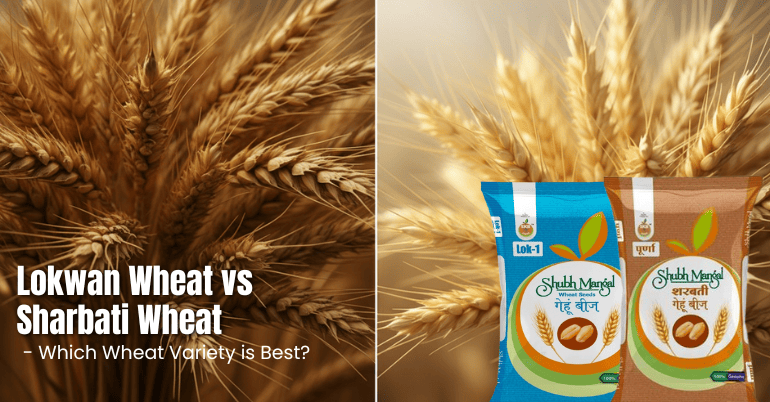
Lokwan Wheat vs Sharbati Wheat is a common question for farmers and buyers. Lokwan is mainly grown in Maharashtra, while Sharbati comes from the MP- Rajasthan region and is known for soft chapatis. In this blog, we compare both varieties in simple words to help farmers choose the right wheat.
Lokwan and Sharbati wheat are grown in India, and the farming conditions are best suited for each variety.
A simple comparison of Lokwan and Sharbati wheat to help farmers and consumers choose the best option based on yield, taste, nutrition, and market value.
|
Factor |
Lokwan Wheat |
Sharbati Wheat |
|
Main Growing Regions |
Mostly grown in Maharashtra and some parts of Madhya Pradesh |
Mainly grown in Madhya Pradesh and Rajasthan |
|
Climate Suitability |
Grows well in a dry to moderate climate |
Needs a moderate climate with good irrigation |
|
Soil Type |
Best suited for black cotton soil (kali mitti) |
Grows best in fertile, loamy soil |
|
Water Requirement |
Needs medium water, suitable for rainfed areas |
Needs medium to high water, better under irrigation |
|
Grain Colour |
Golden yellow grains |
Amber or light brown grains |
|
Grain Size & Hardness |
Bold, hard grains |
Medium-bold, soft grains |
|
Texture |
Hard texture |
Soft texture |
|
Aroma (Smell) |
Strong and natural wheat aroma |
Mild and slightly sweet aroma |
|
Atta (Flour) Colour |
Light yellow atta |
Creamy white atta |
|
Digestibility |
Slightly heavy due to hard grains |
Easy to digest due to soft grains |
|
Calories (per 100g) |
Around 340 kcal |
Around 335 kcal |
|
Protein Content |
Slightly higher (12–13 g), good for strength |
Moderate (11–12 g), balanced nutrition |
|
Dietary Fibre |
High fibre keeps the stomach full |
Good fibre, lighter on the stomach |
|
Minerals |
Rich in iron, magnesium, phosphorus |
Also rich in iron, magnesium, and phosphorus |
|
Average Yield |
25–30 quintals per hectare |
28–35 quintals per hectare |
|
Disease Resistance |
Good resistance to common wheat diseases |
Moderate resistance, needs care |
|
Sowing Time |
October to November |
October to November |
|
Seed Rate |
100–120 kg per hectare |
100–125 kg per hectare |
|
Fertilizer Requirement |
Medium input required |
Medium to high input required |
|
Best Farming Condition |
Performs well in rainfed or limited irrigation |
Performs best in fully irrigated fields |
|
Cooking Uses |
Chapati, bhakri, bread, biscuits |
Soft chapati, roti, sweets, pasta |
|
Taste |
Strong wheat taste, slightly chewy |
Mild, slightly sweet, very soft |
|
Market Demand |
Regular demand from mills and industries |
Premium demand in retail markets |
|
Average Market Price |
₹25–28 per kg |
₹28–32 per kg |
|
Processing Use |
Atta, maida, suji |
Premium atta |
|
Export Potential |
Moderate |
High |
|
Best For Farmers |
Want a stable yield and low risk |
Want a higher price and premium quality |
Lokwan is better for farmers and health, while Sharbati is better for very soft rotis and a premium taste.
|
Wheat Type |
Pros |
Cons |
|
Lokwan Wheat |
Dough is easy to make and handle |
Rotis may become hard a little faster |
|
Rotis puff well and stay soft longer |
The colour may look slightly dark |
|
|
Taste is nutty and filling |
||
|
Healthy wheat with good protein and fibre |
||
|
Good for digestion and sugar control |
||
|
Sharbati Wheat |
Makes very soft and fluffy rotis |
Cost is high compared to Lokwan |
|
Has a slightly sweet taste |
Needs good water and care for the best quality |
|
|
Grain colour is golden and attractive |
||
|
Rotis look good and feel light |
||
|
Sold as premium wheat, so the price is higher |
When comparing Lokwan Wheat vs Sharbati Wheat, there is no single “best” option for all farmers. Choose Lokwan Wheat if you want a reliable yield, lower risk, and suitability for Maharashtra conditions. Choose Sharbati Wheat if you want a higher price, premium quality, and soft chapatis, especially in irrigated areas.
Lokwan Wheat Seeds from SKB Seeds are a smart choice for farmers looking for high-yielding and good-quality wheat. It matures in about 110–115 days and performs well in both irrigated and limited-water conditions. With strong stems that do not fall easily and stable yields every season, Lokwan Wheat from SKB Seeds helps farmers get better harvests and good income.
1. Which wheat is best for chapati?
Sharbati wheat is best for chapatis because it makes soft rotis with a slightly sweet taste.
2. What is Lokwan wheat?
Lokwan wheat is a good quality Indian wheat with big, golden-yellow grains. It is rich in protein and fibre and is commonly used for chapatis and daily meals.
3. What is the quality of Lokwan wheat?
Lokwan wheat is nutritious and healthy. It contains important minerals, is cleanly processed, and gives strong, filling rotis when used as whole wheat atta.
4. What is the other name for Sharbati wheat?
Sharbati wheat is also called the “Golden Grain” because of its golden colour and naturally sweet taste.
5. What is special about Sharbati wheat?
Sharbati wheat is special because it has higher protein and makes very soft, tasty chapatis. It is popular for premium-quality atta.